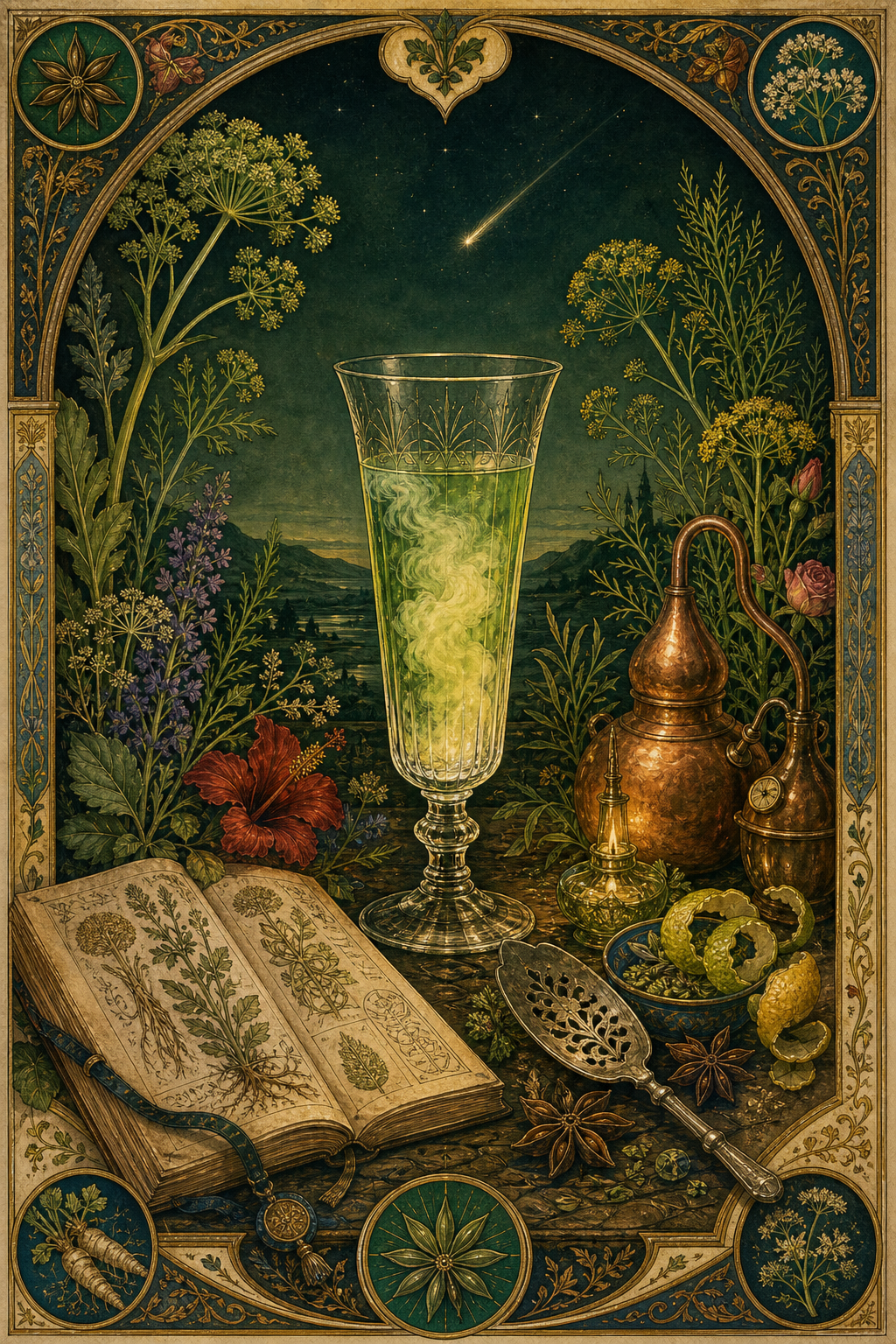
The service grammar
Measure, pour, observe, return
The ritual is not an escape from the ordinary. It is a way of attending to it.
Measure
Use a jigger, a known proof, and a defined water ratio. Reproducibility is part of the beauty.
Pour
Let the water arrive slowly enough for aroma, temperature, and opacity to become visible events.
Return
Close the ritual with water, food, notes, and ordinary conversation. No mythology excuses unsafe service.
The four house serves
One bottle, four thresholds
Verte — The Green Hour
1 oz Verte · 4 oz cold water · sugar optional. Place the spoon over the glass, add sugar only if desired, and drip the water slowly. Watch the green move from transparent edge to full cloud.
Read: bitter backbone, anise body, fennel roundness, hyssop lift, green finish.
Full Verte formulaBleue — The Clear Bloom
1 oz Bleue · 4½ oz very cold water · no sugar. Serve in a clear glass with a slow drip. Keep the table quiet and let the clear spirit remain spare before dilution.
Read: fennel, dry herb, cool air, proof, and the question of whether clarity is a color or a discipline.
Full Bleue formulaDetour — The Yellow Route
1 oz Detour · cold water to taste · expressed lemon or grapefruit peel. Express the peel above the glass, discard or set aside, and keep the garnish restrained.
Read: lemon balm, citrus, resin, yellow-green light, and a departure from heavy licorice.
Full Detour formulaCrimson — The Flowering Shadow
1 oz Crimson · 3½ oz cold water · expressed orange peel. Use the orange only as a bridge into the red finish; do not bury the floral bitterness under garnish.
Read: hibiscus, rosehip, spice, tartness, warmth, and the dramatic table.
Full Crimson formulaCocktail studies
When absinthe leaves the fountain
The Green Beast
1 oz Verte · 1 oz fresh lime juice · 1 oz simple syrup · cold water · ice. Shake the first three ingredients briefly, pour over ice in a tall glass, and add cold water. The bitter spine becomes a long citrus drink.
Death in the Afternoon
1 oz absinthe · chilled sparkling wine. Pour the absinthe into a flute or small wine glass and top slowly. Observe the green aroma rising through the bubbles.
The Sazerac
1½ oz rye or cognac · 1 sugar cube · 3 dashes Peychaud’s bitters · absinthe rinse · lemon expression. Rinse a chilled rocks glass with absinthe. Stir the spirit, sugar, and bitters with ice; strain into the rinsed glass and express lemon.
The Sazerac is the book’s argument in miniature: an aromatic bitter spirit, sugar, dilution, and prepared glass become a complete cocktail architecture.
The N/A Bloom
2 oz zero-proof bitter botanical base · 4 oz cold water · ¼–½ oz citrus cordial · ice optional. Drip or stir slowly. The aim is not to counterfeit alcohol; it is to preserve bitterness, aroma, opacity, and ceremony without proof.
N/A ritual pageFire and spectacle
The flame is a modern mask
Some absinthe rituals end in fire. The history is more interesting when the flame is given its proper date, distance, and danger.
The historical distinction
The classic French and Swiss service is a slow drip of water over a spoon, sometimes with sugar: the glass becomes cloudy, fragrant, and pale. It does not require ignition. The flaming or “Bohemian” serve belongs to a much newer layer of absinthe culture, associated with Czech-style presentation and late twentieth-century revival marketing rather than a documented Belle Époque café custom.
That distinction is not a demotion. It gives the fire its real meaning: not an ancient secret, but a modern theatrical reply to the old ritual. Where the drip reveals an emulsion, the flame announces danger, transformation, and the camera.
A boundary around the image
This book does not publish an ignition procedure and does not recommend lighting alcohol. A high-proof spirit can produce an invisible or hard-to-see flame; heat can fracture or scorch glassware, ignite sugar, linens, clothing, or nearby alcohol, and turn a serving gesture into a burn or fire event. Fire does not make a batch louche, safer, or more historically authentic.
For demonstrations, tastings, and photography, keep the flame separate from the drink and follow local fire rules with trained professionals. The safest house version is an unlit one.
Evidence key: the French/Swiss drip is documented ritual history; the late “Bohemian” flame is modern cultural history; The Unlit Flame is a Nowhere’s End house invention. See the source room.
Tasting flight
Four glasses, one question
- Serve ½ oz of each potion in identical glasses.
- Present them in order: Bleue, Detour, Verte, Crimson.
- Smell before dilution; record the first dominant note.
- Add the same water ratio to each glass and photograph the louche.
- Record color, opacity, aroma, bitterness, sweetness, heat, finish, and return.
- Eat something, drink water, and discuss the differences without assigning drug effects.
The listening pour
Music as invisible botanical
- Begin with room sound and an untouched glass.
- Start the water drip on the first musical pulse.
- Change texture when the louche begins.
- Hold the full cloud for one complete phrase.
- End with silence, food, and notes.
Verte receives low strings and café piano; Bleue receives bells and suspended air; Detour receives a citrus-bright pulse; Crimson receives voice and bowed resonance.
Rituals of Nowhere
Six forms of attention
The Classic Drip
Public, slow, and legible: fountain, spoon, sugar, water, louche.
The Silent Pour
A solitary sensory study with no music and no conversation until the glass finishes changing.
The Listening Pour
The timed musical version, where water, aroma, and sound share one score.
The Garden Pour
Place fresh or dried botanicals beside the glass and name the plant part, origin, and role before serving.
The Laboratory Pour
Compare ABV, water temperature, hardness, dilution, opacity, and aroma as a controlled experiment.
The Shared Table
Serve food, water, and conversation. The social table is not decoration; it is part of the potion’s history.
Cross-reference